Enter SuperBiology explores the fascinating science of deuterium — a naturally occurring isotope of hydrogen — and why its concentration may matter at the molecular level. From isotope effects and cellular chemistry to mitochondrial energy research, discover why deuterium-depleted water is attracting scientific interest and how HydroHealth DDW fits into this emerging field.
Water is everywhere. We drink it, cook with it, wash with it and carry it within virtually every cell of our bodies. Yet when we think about water, we usually think about hydration.
There is another story hidden inside every drop.
Water has an isotopic composition.
And one of those isotopes is deuterium — a naturally occurring, heavier form of hydrogen.
Your body contains it.
So why would anyone want less of it?
To understand that question, we first have to look deeper into what biology actually is.
ENTER BIOLOGY
The human body is usually described in terms of organs and systems: the heart, brain, lungs, liver, muscles and nervous system.
But beneath all of them lies another world.
Cells.
And inside every cell, an extraordinary number of molecular processes are taking place simultaneously.
Proteins fold and unfold. Enzymes accelerate chemical reactions. Molecules cross membranes. Electrons move through metabolic pathways. Protons are transferred. Energy is captured, stored and released.
Life is, at its most fundamental level, chemistry in motion.
And chemistry depends on physics.
The atoms that make up our bodies are not all identical. Elements can exist in different isotopic forms, with the same number of protons but different numbers of neutrons.
Hydrogen provides one of the simplest examples.
Ordinary hydrogen contains one proton and no neutron.
Deuterium contains one proton and one neutron.
Both are hydrogen.
But they are not physically identical.
Deuterium is heavier, and that difference can influence molecular behavior and the rates of certain chemical reactions.
This is known as the isotope effect, a well-established principle of chemistry.
Once chemistry becomes biology, however, the subject becomes considerably more interesting.
WHAT IS SUPERBIOLOGY?
SuperBiology is a way of looking at biology at a deeper level — beyond organs, tissues and conventional nutrition, toward the molecular, chemical and physical processes that make life work.
It asks a simple question:
If biology is ultimately chemistry in motion, could changing the physical and chemical environment in which those reactions occur influence how biological systems function?
SuperBiology focuses attention on things that can be easy to overlook:
molecular structure, reaction kinetics, energy transfer, isotopes, cellular water and the microscopic environment inside the cell.
It is not a medical diagnosis, a treatment system or an established scientific discipline.
It is a perspective.
A way of asking more precise questions about the mechanisms underlying life.
And from this perspective, something as familiar as water suddenly becomes much more interesting.
THE DEUTERIUM QUESTION
Deuterium is not a toxin.
It is not foreign to the human body.
It is naturally present in the water around us and therefore naturally present in our bodies.
The interesting question is one of concentration and biological context.
Because deuterium is heavier than ordinary hydrogen, replacing hydrogen with deuterium can alter the physical behavior of molecules and the rates of certain chemical reactions.
Scientists have studied these effects in chemistry and biology for decades.
The question that follows is fascinating:
Could the isotopic environment surrounding a biological system influence some of the processes occurring within it?
That is very different from saying that deuterium is simply “bad.”
It isn’t.
The scientific interest lies in understanding what happens when biological systems encounter different levels of deuterium.
WHEN CHEMISTRY BECOMES BIOLOGY
At the molecular level, biology is governed by countless reactions.
An enzyme binds to a molecule.
A chemical bond is broken.
Another bond is formed.
A proton moves.
An electron is transferred.
Energy is released or stored.
These events happen continuously and with extraordinary precision.
Because deuterium is heavier than hydrogen, chemical bonds involving deuterium can behave differently from corresponding bonds involving hydrogen.
In some circumstances, those differences can influence reaction rates.
This is one reason isotope effects are so important in biochemical research.
The difference between hydrogen and deuterium may seem tiny.
But biology is built from tiny differences.
A molecular interaction that happens slightly faster or slower can influence a biochemical pathway. A change in one reaction can affect another. And interconnected reactions ultimately create the behavior of the living cell.
This is where the microscopic world becomes relevant to the macroscopic one.
THE MITOCHONDRIAL CONNECTION
Among the most intriguing areas of research is cellular energy metabolism.
Mitochondria are central to the production of ATP, the chemical energy currency used by cells.
Mitochondrial energy production involves highly coordinated processes involving electrons, protons, membranes and molecular gradients.
Hydrogen chemistry is deeply involved in these processes.
And because deuterium behaves differently from ordinary hydrogen, researchers have investigated how variations in deuterium concentration may interact with cellular energy metabolism.
This does not mean that drinking deuterium-depleted water automatically increases energy, reverses aging or treats disease.
Those are clinical claims and require appropriate human evidence.
What it does mean is that deuterium and cellular metabolism represent a legitimate area of scientific investigation.
The fascinating part is precisely the gap between what we already understand and what remains to be discovered.
ENTER DEUTERIUM-DEPLETED WATER
This brings us to deuterium-depleted water, or DDW.
DDW is water in which the concentration of deuterium has been reduced compared with ordinary natural water.
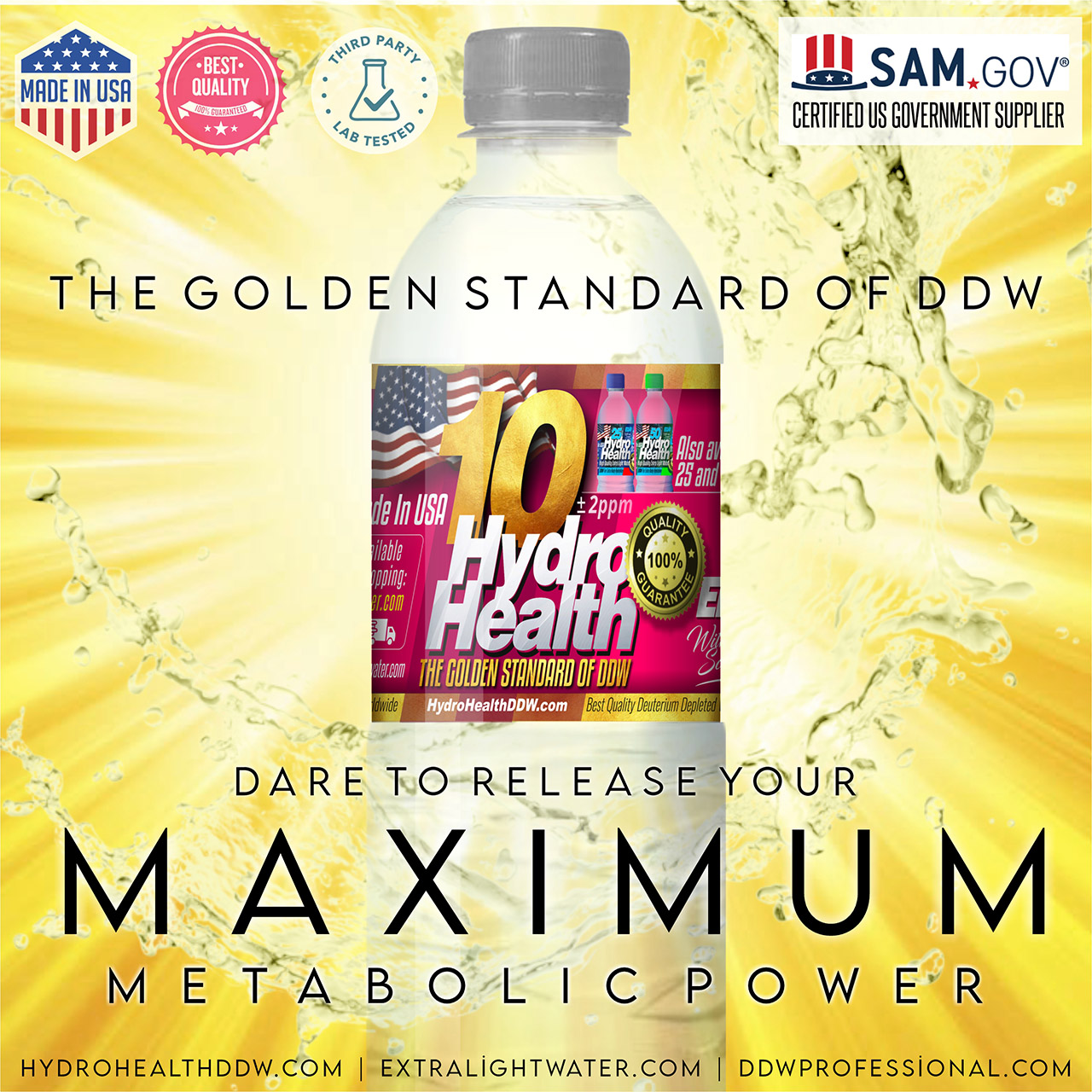
HydroHealth DDW is produced specifically with reduced deuterium concentration and is available in different concentrations.
The difference cannot be seen with the naked eye.
A glass of ordinary water and a glass of DDW can look exactly the same.
The difference is molecular and isotopic.
It can be measured analytically.
And that is precisely what makes DDW interesting.
It is not a different chemical substance.
It is still water.
The distinction lies in the relative abundance of hydrogen isotopes within that water.
WATER AS A BIOLOGICAL ENVIRONMENT
We traditionally think about water in terms of hydration.
Then we learned to think about minerals and electrolytes.
We began paying attention to purity, contaminants, pH and other characteristics.
But isotopic composition represents another dimension of water chemistry.
What if water is not merely something that delivers nutrients and maintains hydration?
What if its molecular composition is also relevant to the environment in which biological reactions occur?
This does not mean that changing the composition of drinking water automatically changes human biology in a predictable way.
It means that the question itself is scientifically interesting.
And it is a question that can be investigated.
WHY WOULD ANYONE WANT LESS DEUTERIUM?
This is where the title question comes back.
Your body contains deuterium.
So why would anyone want less of it?
The answer is not that deuterium is inherently harmful.
Nor is the answer that less is always better.
The scientific rationale is more nuanced:
different isotopic environments can produce different molecular behavior.
DDW research explores what happens when the concentration of naturally occurring deuterium is reduced.
That research spans molecular mechanisms, cellular studies and experimental models, while questions about meaningful health outcomes in humans require rigorous clinical investigation.
For HydroHealth, this distinction matters.
The goal is not to turn an intriguing area of science into a miracle claim.
The goal is to make the science accessible and encourage a deeper understanding of something most of us have never thought about:
the isotopic composition of the water we drink.
FROM ORDINARY BIOLOGY TO SUPERBIOLOGY
Traditional health conversations tend to focus on large things.
Organs.
Diseases.
Symptoms.
Calories.
Vitamins.
Minerals.
But modern biology increasingly moves in the opposite direction.
Toward smaller and smaller scales.
Cells.
Molecules.
Chemical bonds.
Electrons.
Protons.
Isotopes.
At this scale, apparently insignificant differences can become measurable.
One additional neutron changes hydrogen into deuterium.
That changes mass.
Different mass can influence molecular behavior.
Molecular behavior influences chemical reactions.
Chemical reactions create biological processes.
And biological processes create life as we experience it.
This is the intellectual territory we call SuperBiology.
Not “better biology.”
Not a promise of superhuman health.
Rather, a deeper look at the physical and molecular environment in which biology takes place.
THE NEXT FRONTIER MAY BE INVISIBLE
Some of the most important things in biology cannot be seen.
We cannot see an enzyme working.
We cannot see an electron moving through a metabolic pathway.
We cannot see a proton gradient inside a mitochondrion.
And we cannot look at a glass of water and tell whether it contains more or less deuterium.
Yet these invisible details are part of the physical reality of life.
Science progresses by learning how to measure what we cannot see.
That is what makes the study of isotopes so compelling.
And that is why deuterium-depleted water deserves to be discussed not simply as another type of drinking water, but as part of a broader scientific conversation about water, chemistry and biology.
A NEW WAY OF THINKING ABOUT WATER
Perhaps the most interesting thing about DDW is not a single promised benefit.
It is the question it makes us ask.
We have spent centuries studying water.
We know its chemistry.
We understand its importance to life.
We know that our bodies depend on it.
But science continues to reveal layers of complexity hidden within seemingly simple substances.
Deuterium is one of those layers.
And the possibility that isotopic composition could interact with biological processes opens another door.
SuperBiology is about walking through that door.
It is about looking beyond the obvious.
Beyond hydration.
Beyond the visible.
Beyond the assumption that two glasses of water must be biologically identical simply because they look the same.
The future of biology may depend not only on discovering new substances, but on understanding familiar substances at an increasingly precise level.
And sometimes, the most interesting scientific questions begin with the simplest ones.
Your body contains deuterium.
So why would anyone want less of it?
Enter SuperBiology.