What if the next frontier in wellness wasn’t about adding more to your routine—but rethinking something you drink every single day?
We count calories. We track steps. We optimize sleep, explore supplements, and search for better ways to support our health. Yet one fundamental element of our daily lives rarely gets a second thought: water.
Not all water is identical at the molecular level. Hidden within ordinary water is a naturally occurring form of hydrogen called deuterium—and scientists are investigating how this heavier isotope may influence the intricate chemistry of living cells.
Enter deuterium-depleted water (DDW): water with a lower concentration of deuterium than conventional water.
It is a different perspective on hydration, grounded in a fascinating scientific question: could the isotopic composition of the water we drink matter to our cellular biology?
The answer is still being investigated. But the science is intriguing enough to deserve a closer look.
1. The Invisible Difference: What Makes Water “Heavy”?
Hydrogen is the simplest and most abundant element in the universe. Most hydrogen atoms have a single proton in their nucleus. Deuterium, a naturally occurring stable isotope of hydrogen, contains both a proton and a neutron.
That extra neutron makes deuterium approximately twice as heavy as ordinary hydrogen.
Deuterium occurs naturally in the oceans, rivers, rainfall, food, and the water inside our bodies. It is not radioactive, and its presence in ordinary water is entirely natural.
But mass matters in chemistry.
Replacing ordinary hydrogen with deuterium can alter the rates of certain chemical reactions—a phenomenon known as the kinetic isotope effect. In biological systems, such differences have prompted researchers to investigate how deuterium interacts with enzymes, cellular structures, and metabolic pathways.
Our mitochondria, often described as the powerhouses of our cells, are particularly interesting in this discussion. They help convert nutrients into ATP, the molecule that supplies energy for countless biological processes.
Scientists studying deuterium biology are exploring whether changing the deuterium concentration in the body’s water can influence these processes.
This is where DDW enters the picture.
Not as a miracle cure. Not as a replacement for good nutrition or medical care. But as a distinctive approach to hydration that raises important questions about the relationship between water chemistry and cellular function.
2. DDW: Less Deuterium, A Different Approach to Hydration
Deuterium-depleted water is produced through specialized processes that reduce its deuterium concentration below that of conventional water.
Ordinary drinking water typically contains deuterium at approximately 150 parts per million (ppm), although natural levels vary according to geography and water source.
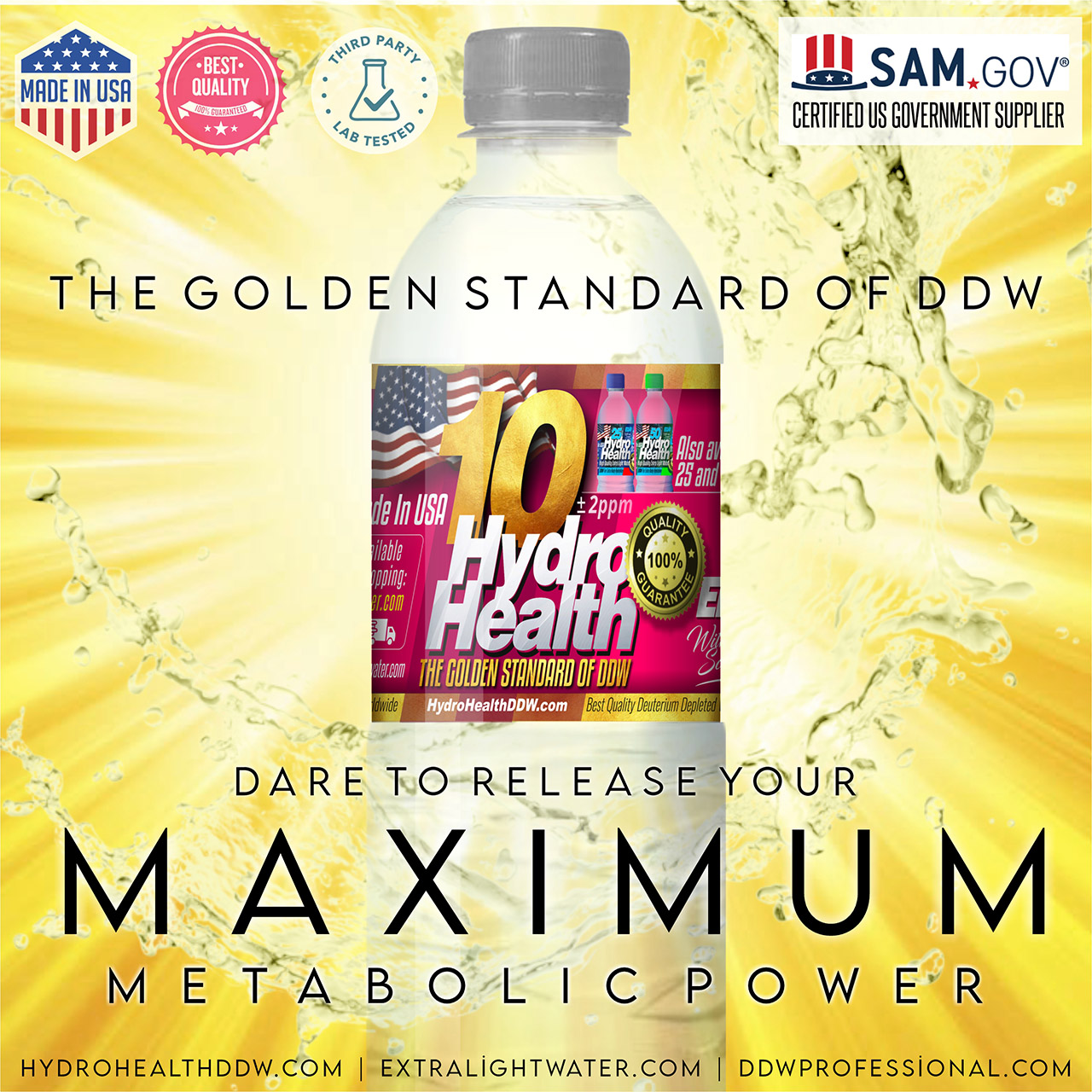
DDW is available in different concentrations, including 125 ppm, 100 ppm, 50 ppm, 25 ppm, and lower, depending on the product and its intended application.
The lower the ppm value, the lower the deuterium concentration.
This does not mean that ordinary drinking water is inherently bad or that deuterium is a poison. The body naturally contains deuterium, and it plays a part in normal biological chemistry.
The idea behind DDW is more specific: to reduce the amount of deuterium introduced through drinking water and investigate whether this change can influence the body’s overall deuterium balance.
Think of it as a different dimension of water quality—not simply what is in your water, but also the isotopic composition of the water itself.
For people interested in emerging research on metabolism, mitochondrial biology, and cellular health, DDW offers an opportunity to explore this developing field.
3. The Cellular Energy Connection
Energy is fundamental to life.
Every heartbeat, every muscle contraction, every thought, and every repair process depends on a complex network of biochemical reactions. Much of this activity relies on mitochondria and their production of ATP.
Deuterium research has attracted attention because hydrogen isotopes can behave differently during chemical reactions. Researchers are investigating whether variations in deuterium concentration can influence mitochondrial processes and the regulation of cellular metabolism.
Some experimental studies suggest that deuterium depletion may affect cellular energy pathways and the expression of genes involved in metabolic regulation.
What might this mean for everyday wellness?
Potential areas of interest include:
- Cellular metabolism: Investigating how deuterium concentration affects biochemical pathways involved in energy production.
- Mitochondrial function: Exploring whether changing the isotopic environment can influence the processes through which cells generate energy.
- Metabolic regulation: Examining possible connections between deuterium balance and the mechanisms that regulate cellular activity.
- Healthy aging research: Understanding whether these mechanisms have relevance to age-related changes in cellular function.
These are research questions, not established promises of improved energy, endurance, longevity, or disease prevention in humans. Larger, well-designed clinical studies are needed to determine whether the experimental findings translate into meaningful health benefits.
Nevertheless, this emerging area of research offers a compelling reason to look beyond conventional ideas about hydration.
4. DDW and Cancer Research: A Promising Question, Not a Proven Cure
Cancer is one of the most complex challenges in modern medicine. It involves changes in cellular growth, genetic regulation, metabolism, and the interactions between tumors and their surrounding environment.
Researchers are increasingly interested in the metabolic characteristics of cancer cells, including how they produce and use energy.
Within this broader field, deuterium-depleted water has become the subject of experimental and limited clinical research.
What does the research show?
A 2024 systematic review published in Nutrients examined 15 studies investigating DDW in cancer-related research. Fourteen involved laboratory experiments or animal models, while one was an interventional human study.
The review reported encouraging findings in several experimental settings, including research examining tumor growth and the potential effects of combining DDW with conventional cancer treatments.
Scientists have explored possible mechanisms involving cellular signaling, oxidative stress, and pathways associated with the regulation of cell growth.
These findings have led researchers to investigate whether deuterium depletion could eventually have a role as an adjunct to established cancer therapies.
Could DDW become an adjuvant in cancer treatment?
An adjuvant is an intervention used alongside a primary treatment in an attempt to improve outcomes. In cancer care, that may mean investigating an additional approach alongside surgery, chemotherapy, radiotherapy, or other prescribed treatments.
The possibility that DDW could have such a role is scientifically interesting. However, the available evidence remains preliminary, and the clinical research is insufficient to establish DDW as an effective cancer treatment or a proven means of improving the results of conventional therapy.
The distinction matters.
Laboratory findings do not necessarily predict what will happen in a human patient. Animal studies cannot establish clinical effectiveness, and a limited number of human observations cannot demonstrate that a product reliably treats cancer.
Further independent, adequately powered, randomized clinical trials are needed to determine whether DDW provides a meaningful benefit, which concentrations might be appropriate, and how it could be used safely alongside specific treatments.
DDW should not be presented as a cancer cure, and it must never replace or delay evidence-based cancer care. Anyone considering it during cancer treatment should first consult their oncologist.
The promise of scientific research lies not in making premature claims, but in investigating promising questions carefully enough to discover what genuinely works.
And the question of deuterium depletion is one that researchers continue to explore.
5. Beyond Cancer: The Broader Interest in Deuterium Biology
Cancer research is only one part of a much larger scientific conversation.
Deuterium biology also raises questions about the relationship between isotope balance and metabolic regulation. Research in this area has investigated possible connections to obesity, diabetes, cellular signaling, and other processes associated with chronic disease.
Some experimental findings have suggested that deuterium depletion may influence biological pathways involved in these conditions.
But an important distinction remains between identifying a mechanism in a laboratory and demonstrating a benefit in people.
At present, there is not sufficient high-quality clinical evidence to conclude that drinking DDW prevents cancer, treats diabetes, reverses neurological disease, slows aging, or improves physical performance in the general population.
That does not make the research uninteresting. It means that its potential must be evaluated through rigorous science rather than assumed from a plausible mechanism.
For health-conscious consumers, the practical takeaway is straightforward: DDW offers a way to explore an emerging field of hydration research, while established foundations of health—balanced nutrition, physical activity, adequate sleep, and appropriate medical care—remain essential.
6. Why Consider Switching to DDW?
Most of us choose water according to taste, purity, convenience, and price. DDW introduces another consideration: deuterium concentration.
For those who want to explore this emerging area, switching to deuterium-depleted water can be a deliberate choice to reduce deuterium intake through drinking water.
The potential value of that choice is the subject of ongoing investigation. Whether it produces measurable improvements in health, and for whom, remains to be established.
Before choosing a product, consider three things:
Know your ppm. A lower deuterium concentration means less deuterium in the water. Compare products based on their stated concentration and reliable analytical testing.
Know your source. Look for transparent production information, quality-control procedures, and independent laboratory results where available.
Know the limits of the science. Be wary of products that promise guaranteed disease prevention, cancer remission, or dramatic improvements in health without adequate clinical evidence.
A thoughtful approach to wellness begins with informed choices—not exaggerated promises.
7. Make Your Water Choice More Conscious
The science of water is more fascinating than it first appears.
A molecule that seems almost too simple to question can contain subtle differences with implications for chemistry and biology. Deuterium is a natural part of that story, and DDW represents an effort to investigate what happens when its concentration in drinking water is reduced.
We do not yet have all the answers. The evidence supporting broad health benefits remains incomplete, and the clinical significance of deuterium depletion is still being studied.
But for people interested in emerging science and more intentional hydration, the concept deserves a place in the conversation.
You don’t have to believe every bold claim to appreciate a compelling scientific question. You simply have to be willing to look closer.
HEAVY BAD. LIGHT GOOD.
Not because ordinary water is bad. Not because deuterium should be eliminated from the body.
But because understanding the difference between ordinary water and deuterium-depleted water opens the door to a new way of thinking about hydration—and to research that may help clarify the role of hydrogen isotopes in human biology.
Choose informed hydration. Explore the science. Discover DDW.
Because sometimes, the smallest differences are the ones worth investigating.
Scientific references
- Lu, Y. & Chen, H. (2024). Deuterium-Depleted Water in Cancer Therapy: A Systematic Review of Clinical and Experimental Trials. Nutrients, 16(9), 1397. Read the full scientific review.
- Korchinsky, N., Davis, A. M. & Boros, L. G. (2024). Nutritional deuterium depletion and health: a scoping review. Metabolomics, 20, 117. Read the review.
Medical disclaimer: This article is for educational and informational purposes only and does not constitute medical advice. Deuterium-depleted water has not been established as a treatment or cure for cancer or other diseases. It should not replace prescribed treatment or professional medical guidance. Consult a qualified healthcare professional before making changes to your hydration routine, particularly if you have a medical condition or are receiving cancer treatment.