

Could your gut bacteria influence the hydrogen powering your cells? A new wave of deuterium research is connecting microbial hydrogen cycling, metabolic water, ketosis, and mitochondrial efficiency in ways that may reshape how we understand energy, aging, and chronic disease.
From the science of “mitochondrial isotope stress” to the growing interest in deuterium-depleted water, this emerging field offers a fascinating glimpse into the hidden chemistry of human metabolism.
For years, deuterium-depleted water (DDW) was discussed almost exclusively as a niche cancer-support therapy. But a newer and far more fascinating perspective is beginning to emerge from the intersection of mitochondrial biology, microbiome science, ketogenic metabolism, and isotope research:
What if the body already possesses its own internal deuterium-regulation system?
And what if the gut microbiome is one of its most important hidden controllers?
To understand why researchers are increasingly interested in this possibility, it helps to begin with hydrogen itself.
Hydrogen is the most abundant element in the human body. But not all hydrogen is the same. A small fraction exists as deuterium — a heavier isotope containing an extra neutron. Though chemically similar to normal hydrogen, deuterium behaves differently inside living systems. Because it is heavier, it forms stronger chemical bonds and moves more slowly through delicate molecular machinery.
And nowhere is this more important than inside the mitochondria.
Think of mitochondria as microscopic hydroelectric turbines inside your cells. Their job is to generate energy by moving hydrogen ions across membranes at incredible speed and precision. Researchers now believe excess deuterium may act almost like “biological sand” inside these turbines — subtly slowing energy transfer, increasing oxidative stress, and forcing cells to work harder to produce ATP, the body’s energy currency.
This is the foundation of the emerging concept known as mitochondrial isotope stress.
Now comes the truly interesting part: your gut microbes may influence this entire process.
The human microbiome constantly participates in hydrogen metabolism. Certain bacteria produce hydrogen during fermentation, while others consume and recycle it. This microbial hydrogen cycling creates a vast biochemical ecosystem capable of influencing the hydrogen balance inside the body itself.
Some researchers now suspect this system may also influence deuterium handling.
In other words, the microbiome may help determine not only how much hydrogen the body processes, but what kind of hydrogen predominates in metabolic reactions.
This connects directly to ketogenic metabolism.
When the body burns carbohydrates, it generates metabolic water with a different isotopic profile than when it burns fat. Fat oxidation appears to produce metabolic water naturally lower in deuterium. This may partly explain why ketosis and fasting are often associated with improved mitochondrial efficiency, reduced inflammation, steadier energy, and neurological benefits.
From this perspective, ketosis may function partly as a natural deuterium-depletion strategy.
Researchers have also explored DDW in relation to conditions involving mitochondrial dysfunction or oxidative stress, including:
* cancer metabolism,
* diabetes,
* chronic fatigue,
* neurodegenerative disease,
* autoimmune disorders,
* depression,
* cardiovascular disease,
* obesity and metabolic syndrome.
While human clinical evidence remains limited and many mechanisms are still theoretical, the biological story itself is increasingly compelling.
The body may not simply rely on drinking water to regulate deuterium.
It may use:
* microbiome activity,
* fat metabolism,
* circadian biology,
* sleep quality,
* and mitochondrial efficiency
to maintain an optimal isotopic environment.
This is where high-quality DDW products enter the picture.
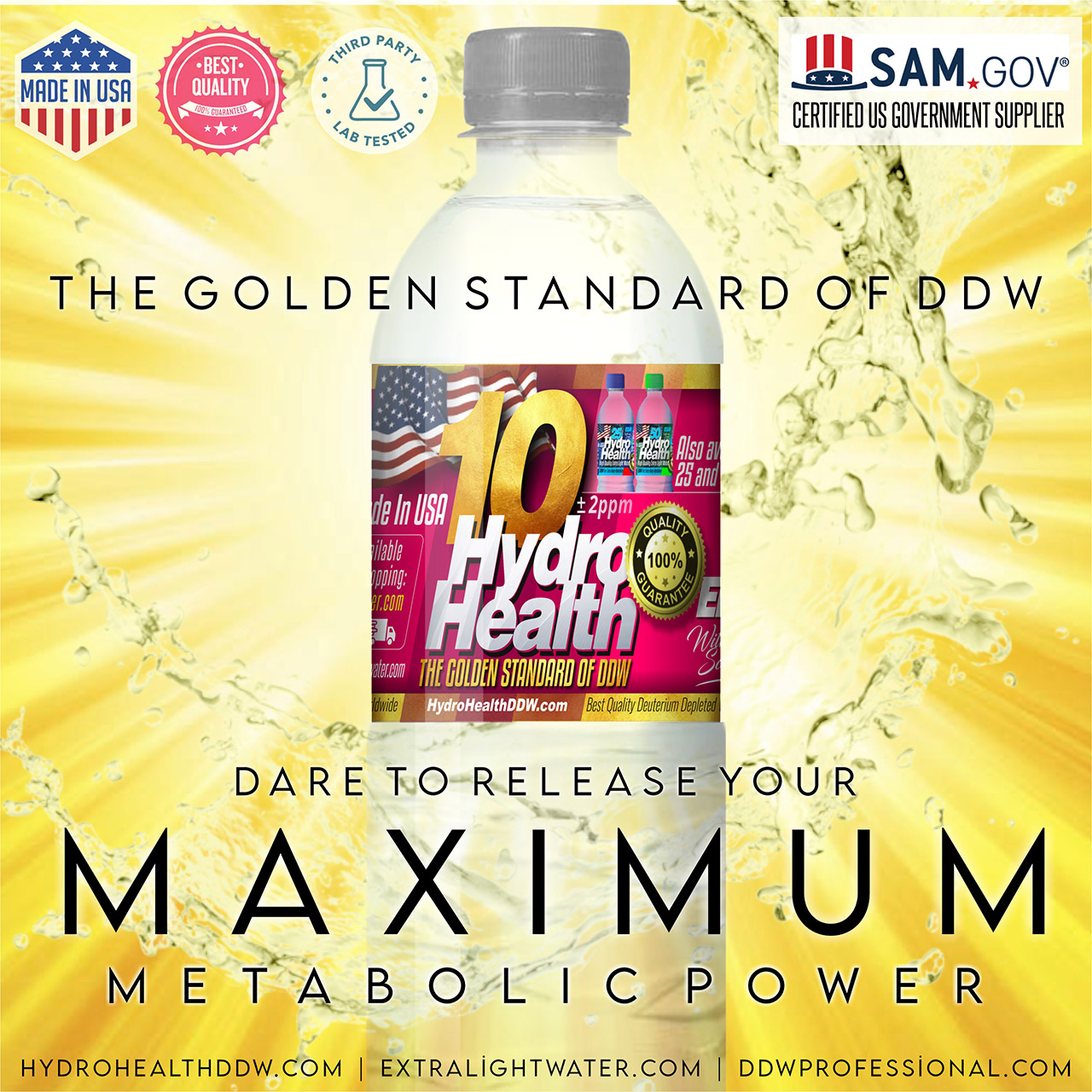
HydroHealth DDW is the only deuterium-depleted water manufactured in the USA: Rigorous production standards, frequent independent isotopic testing, and certified laboratory verification through Isotech Laboratories in Illinois. Listed as a SAM.gov-certified government supplier.
HydroHealth offers multiple concentrations — including 50 ppm, 25 ppm, and ultra-low 12 ppm formulations — allowing users to gradually lower deuterium exposure depending on budget and protocol goals. Independent lab reports published by the company show batches occasionally testing even lower than labeled values.
For many users interested in mitochondrial optimization, longevity, ketogenic metabolism, or recovery from chronic illness, DDW is increasingly viewed as part of a broader metabolic strategy.
A strategy centered on one fascinating idea:
That life itself may depend not only on water…
…but on the quality of the hydrogen inside it.